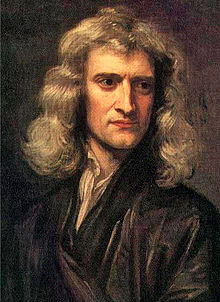
Isaac Newton had an unbelievable impact on the Age of Enlightenment. He, on a basic level, oversaw the transition from the Renaissance period to one where knowledge and discovery was not controlled by religion. His scientific and mathematic discoveries and ideas aided the major change in thought that is the Enlightenment Period. His major contributions include:
- discovery of gravity
- the creation of Calculus
- a new model of the universe (Newton’s Theory and Three Laws of Motion)
- discovery of the color spectrum
- creation of the reflecting telescope
Newton attended Cambridge University from 1661-1665, and in 1667 he returned to Cambridge and was elected Minor Fellow. After creating the first reflecting telescope in 1668, he was elected into the Royal Society in 1672. However, he was majorly criticized by fellow and more established Society member Robert Hooke, and in 1678 he retracted from the public eye. In the following years he would collect his notes for his “Philosophiae Naturalis Principia Mathematica” (Mathematical Principles of Natural Philosophy) which discussed his three laws of motion and discoveries in universal gravity. Hooke’s death in 1703 allowed Newton to become president of the Royal Society, where he would be able to continue his work and make it available for society, and therefore continue his tremendous contribution to the Enlightenment.
 Science & Technology