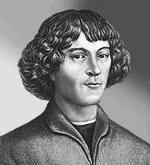
Nicolaus Copernicus

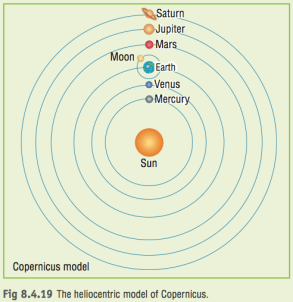
 (the man created the Heliocentric model of the Universe)

21488.jpgBased on ongoing observations of the motions of the planets, as well as previous theories Copernicus proposed a model of the Universe where the Earth, the planets and the stars all revolved around the Sun. In so doing, he resolved the mathematical problems and inconsistencies arising out of the classic geocentric model and laid the foundations for modern astronomy.Heliocentric_model.png

Refined Telescopes


Reflector telescopes continued in into the 1700’s. Even though Newton had designed a better telesHerschel_40_foot.jpgcope, other craftsmen and scientists were unable to grind mirrors of regular curvature (curving of the lense). These mirrors at the time were made by adding arsenic (steel), to a copper-tin alloy. The arsenic made the mirror easier to polish, but the constant polishing affected the curvature of the mirrors further.
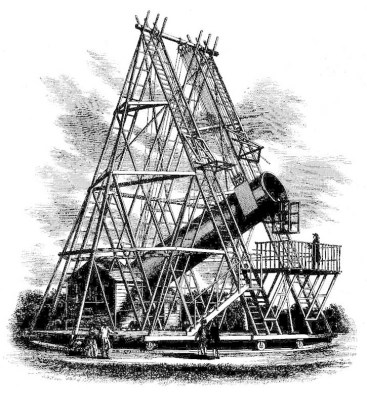
Two men would work in England that would improve upon Newton’s telescope. The first man was an inventor, John Hadley, who after many trials created a new style of mirror made from speculum, a compound of silver and bronze. His first telescope was a Newtonian telescope with a focal length of 62 inches and a diameter of 6 inches. It was said to “enlarge an object near two hundred times”. The success of Hadley’s telescope was in his ability to polish the mirror in a way to create a refined parabolic shape creating little distortion. In telescopes, parabolic reflectors are used to collect starlight from a distant source and bring it to a common focal point.

The second englishman who improved the design of the Newtonian telescope was a musician, William Herschel. Herschel design a telescope of 20ft in length with a 19in diameter lens. The metal mirrors caused severe issues with tarnishing, still requiring both men to polish frequently. Hadley had created multiple lenses for his telescope enabling him to use one while polishing the other. However, the amount of time spent polishing limited the popularity of this style of telescope.
 

Universal Gravitation

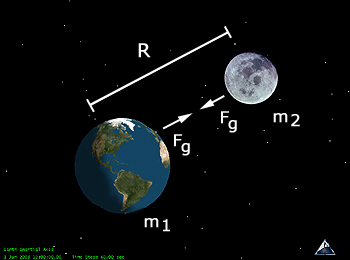
Isaac Newton compared the movement of the moon to the movements of objects on earth. Believing that gravitational forces were responsible for each. Newton was able to conclude that gravity depended upon distance. This comparison led him tomath-18.jpg a conclusion that the force of gravitational attraction between the Earth and other objects is inversely proportional to the distance separating the earth’s center from
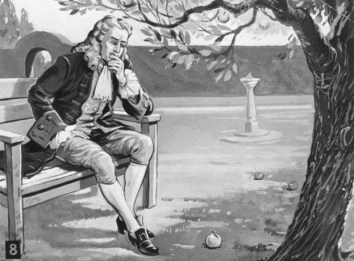
the object’s center. But distance is not the only variable affecting the magnitude of a gravitational force. Consider Newton’s famous equation

(Fnet = m • a
)                                                

2

Newton knew that gravity acted on the apple making it fall to the ground was caused by gravity.  Since the force acting to cause the apple’s downward motion also causes the earth’s upward acceleration (Newton’s third law) that force must also depend on the mass of the earth.

Halley’s Comet

Halley’s Comet is arguably the most famous comet. It is a “periodic” comet and returns to Earth’s vicinity about every 75 years, making it possible for a human to see it twice in their lifetime. The last time it was here was in 1986, and it is projected to return in 2061.img_0125_3

The comet is named after English astronomer Edmond Halley, who examined reports of a comet approaching Earth in 1531, 1607 and 1682. He concluded that these three comets were actually the same comet returning over and over again, and predicted the comet would come again in 1758.

Halley didn’t live to see the comet’s return, but his discovery led to the comet being named after him. (The correct pronunciation of his name rhymes with valley).

Intellectual

This word directly relates to the field of technological advancements made during the Age of Reason. The greatest minds of the era were focused on expanding intellectual thought and creating a more fact-based society. Scientists and philosophers began to move away from the teachings of the Church, and they started to think for themselves in order to discover new ideas and theories about the natural world, never yet conceived of. The entire Age of Reason was an intellectual movement away from traditional, religious beliefs, and towards a new, science based and fact driven society.

Discovery

This blog is purely dedicated to the growth and wonders of technology during the Age of Enlightenment. Keep on scrolling to be enlightened!

Benefits of the Age of Reason in Great Britain

Due to increasing popularity of secularism and movement away from the Church, more and more scientists began to openly criticize and challenge traditional beliefs and ideas. This led to a more intellectual society that began to trust facts and scientific evidence more than the beliefs put forth by the Church. One prominent scientist of the time, Sir Francis Bacon, began conducting experiments using methodical, careful methods of gathering and analyzing evidence. His methods became widely popular and he was instrumental in establishing the Scientific Method, which set the basis for all future scientific endeavors. More major impacts on Great Britain, as well as the rest of Europe, were made by John Locke. At Oxford University, Locke studied medicine, which became a central component of his life after graduation.He formulated revolutionary ideas concerning religion, government, philosophy, and medicine. His publication, “Essay Concerning Human Understanding” laid the groundwork many more of the Enlightenment’s key philosophical and intellectual advances.

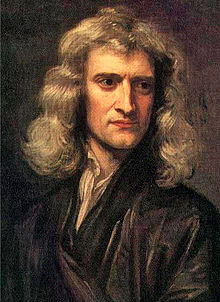
Isaac Newton

isaac

Isaac Newton had an unbelievable impact on the Age of Enlightenment. He, on a basic level, oversaw the transition from the Renaissance period to one where knowledge and discovery was not controlled by religion. His scientific and mathematic discoveries and ideas aided the major change in thought that is the Enlightenment Period. His major contributions include:

  • discovery of gravity
  • the creation of Calculus
  • a new model of the universe (Newton’s Theory and Three Laws of Motion)
  • discovery of the color spectrum
  • creation of the reflecting telescope

Newton attended Cambridge University from 1661-1665, and in 1667 he returned to Cambridge and was elected Minor Fellow. After creating the first reflecting telescope in 1668, he was elected into the Royal Society in 1672. However, he was majorly criticized by fellow and more established Society member Robert Hooke, and in 1678 he retracted from the public eye. In the following years he would collect his notes for his “Philosophiae Naturalis Principia Mathematica” (Mathematical Principles of Natural Philosophy) which discussed his three laws of motion and discoveries in universal gravity. Hooke’s death in 1703 allowed Newton to become president of the Royal Society, where he would be able to continue his work and make it available for society, and therefore continue his tremendous contribution to the Enlightenment.

Concerns of the Era

The Age of Reason, also referred to as the Enlightenment was a very well known and appreciated era for many technological and other forms of advancement. The Enlightenment was a great intellectual movement. The advancements that took place, for the most part, were very beneficial, though there were some concerns that came along with the many new found discoveries. In terms of the science and technological advancements, the most prominent concern was secularism. The term secularism is defined as a belief system that rejects religion, or the belief that religion should not be part of the affairs of the state or part of public education. This general idea of the separation of the old and more traditional ways to reason and logic was very controversial at this time.