Reflector telescopes continued in into the 1700’s. Even though Newton had designed a better teles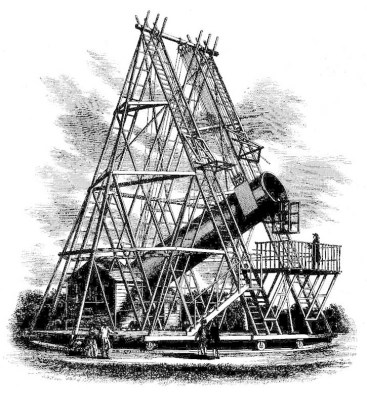 cope, other craftsmen and scientists were unable to grind mirrors of regular curvature (curving of the lense). These mirrors at the time were made by adding arsenic (steel), to a copper-tin alloy. The arsenic made the mirror easier to polish, but the constant polishing affected the curvature of the mirrors further.
Two men would work in England that would improve upon Newton’s telescope. The first man was an inventor, John Hadley, who after many trials created a new style of mirror made from speculum, a compound of silver and bronze. His first telescope was a Newtonian telescope with a focal length of 62 inches and a diameter of 6 inches. It was said to “enlarge an object near two hundred times”. The success of Hadley’s telescope was in his ability to polish the mirror in a way to create a refined parabolic shape creating little distortion. In telescopes, parabolic reflectors are used to collect starlight from a distant source and bring it to a common focal point.
The second englishman who improved the design of the Newtonian telescope was a musician, William Herschel. Herschel design a telescope of 20ft in length with a 19in diameter lens. The metal mirrors caused severe issues with tarnishing, still requiring both men to polish frequently. Hadley had created multiple lenses for his telescope enabling him to use one while polishing the other. However, the amount of time spent polishing limited the popularity of this style of telescope.
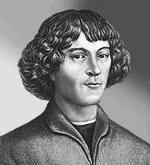 Based on ongoing observations of the motions of the planets, as well as previous theories Copernicus proposed a model of the Universe where the Earth, the planets and the stars all revolved around the Sun. In so doing, he resolved the mathematical problems and inconsistencies arising out of the classic geocentric model and laid the foundations for modern astronomy.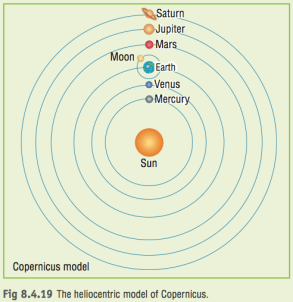
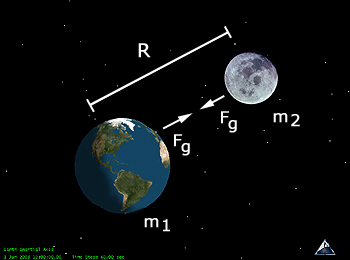 a conclusion that the force of gravitational attraction between the Earth and other objects is inversely proportional to the distance separating the earth’s center from

 Science & Technology